
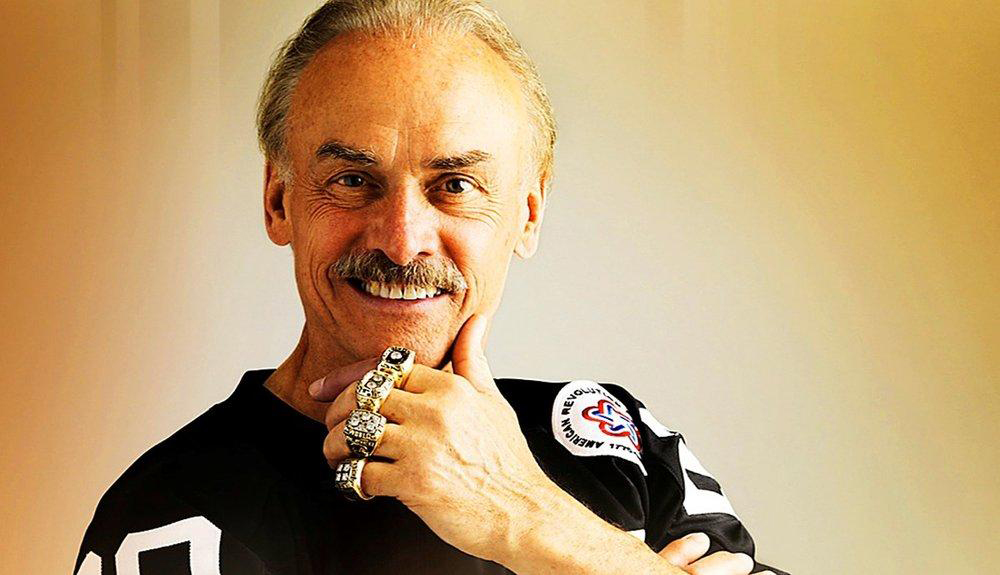

Robert “Rocky” Bleier was born on March 5, 1946, in Appleton, Wisconsin. He is the oldest of four children to Bob and Ellen Bleier. Bleier was a three-sport athlete at Xavier High School in Appleton, competing in football, track, and basketball (he was a captain for all three sports).
During his time at Xavier, Bleier was an all-conference selection as a linebacker and defensive back. Bleier made such an impression as a prep star that he was sought by nearby colleges. Staying near home, he accepted a scholarship offer from the University of Notre Dame. During the 1966 season, Notre Dame finished 9-0-1 and won the national championship. That season, Bleier rushed 63 times for 282 yards and four scores along with four receptions for 17 yards and one touchdown.
Bleier’s teammates voted him team captain during his senior year in 1967. Before the last game of his senior year, Bleier suffered a torn ligament. Rocky missed the final game, and it looked like that would be the end of his career as a football player.
A few months later, Bleier was having dinner with friends when some of his buddies overheard an area sportscaster who was announcing a list of local college players who had been selected during the third day of the 1968 NFL Draft.
As a rookie in 1968, Bleier didn’t get much playing time. He toted the ball six times for 39 yards and had three receptions for 68 yards. Then in December, his first season was cut short due to an unexpected draft letter from the local Draft Board. He was drafted to serve in the military during the Vietnam War. Bleier informed the Steelers and then volunteered for duty in South Vietnam. After eight weeks of basic training and another eight weeks for advanced infantry training, Bleier was shipped off to Vietnam in April of 1969. He was in-country for only a few months stationed with the 196th Light Infantry Brigade at Hiep Duc Valley, near Danang, at a post called LZ Siberia when his unit received a call that would greatly affect his life. His company received a call from their sister company in August 1969 saying they were being ambushed by North Vietnamese soldiers and had many wounded and casualties. Bleier who carried a grenade launcher, and his unit were flown to help extract the ambushed company. “We didn’t get to them until late at night and when we finally got there.” We ran into the ambush, but things didn’t go as planned. The NVA were entrenched—deadly, ferocious, unseen but seemingly everywhere—and Company C walked into the firefight not knowing they were outmanned four to one. They battled through two bad days and brutal nights. On the morning of Aug. 20, 1969, Bleier and a few others emerge from some woods into a clearing when they come under fire from an NVA machine gun. Bleier grabs his grenade launcher and crawls about 20 yards to get a bead on the machine gun. It is 40 yards away. Bleier loads and … feels a dull thud in his left thigh. He’s shot in the leg and is pinned down by enemy fire. Any bandages he carries are in his pack, in the open where he left it behind. Still, hoping to provide cover for others, he lobs a few rounds where the automatic weapons’ fire is coming from. He drags his body and weapon to some protective bushes.
From this position Bleier can’t see the machine gun’s location, but others call out and direct his aim as he lobs grenades—three dozen rounds—toward the source of the enemy fire. Then, out of ammunition, Bleier lies still, for almost two hours, and waits. He prays to God that he gets out of there alive.
In time Bleier and others begin a long crawl to safety. Twenty-two of them together now, including five wounded.
130 NVA silently followed and about 2 p.m. the NVA assault resumes. A NVA grenade exploded at Bleier’s feet, that left his right leg quivering uncontrollably, his right foot maimed, and his body riddled with shrapnel. The NVA retreated as a third platoon arrived to evacuate the wounded and get them to a medevac helicopter poised two miles away. Rocky and his fellow soldiers were extracted. Rocky was then medevacked to Japan where doctors removed 100 shards of shrapnel from his shredded foot and leg. He was told that he would never walk again, never mind play professional football. Rocky was awarded the Bronze Star and a Purple Heart for his military service.
Bleier began the arduous rehabilitation process on his foot.
In 1970 Rocky received a note from Steelers owner Art Rooney stating “Rock, the team’s not doing well, we need you.” Rooney also informs Rocky that he has been placed on the team’s injured reserve list. Rooney, when he first learned of Bleier’s injuries, decided to pay Rocky’s $20,000 injured reserve salary so the war veteran could stick with his rehab. Rooney also pays for further surgeries.
Bleier with one foot shorter than the other, shoes of different sizes, returns to the Steelers and would become an essential force in one of the NFL’s most celebrated dynasties.
1970-1971 - Pittsburgh Steelers Injured Reserve and Steelers Taxi Squad.
Rocky spent 2 full years of intense training and rehab to regain his spot in the active roster.
1972 -Active Roster for the Pittsburgh Steelers lineup.
1974- Earned a spot in the starting backfield. The Steelers went on to win their first Super Bowl.
1975- Steelers vs Packers. One of the best games of Rocky’s career. Rushed for 163 yards. Steelers go on to win their second Super Bowl.
1977- Scored the "go-ahead" touchdown in Super Bowl XIII.
1978- Steelers win their 4th Super Bowl.
1980-Rocky Retired from the Pittsburgh Steelers. Four-time Super Bowl Champion (IX; X; XIII; XIV)
1980 to Present- President, Rocky Bleier, Inc.
Rocky Bleier was inducted into the Steelers Hall of Honor as a member of the Class of 2018.
Rocky Bleier finished his career with 25 touchdowns and 136 receptions for 1,294 yards and 3,855 yards rushing, including 1,036 in 1976 when both he and Franco Harris finished the season with over 1,000 yards rushing. Bleier is presently ranked ninth in the Steelers all-time rushing list. But it was Bleier’s ability to get the tough few yards, to make the clutch catch, to throw the critical block—and his life of service and perseverance—that made him a fan favorite in blue-collar Pittsburgh, and across America. Rocky Bleier, a story of honor, sacrifice, courage, and singular triumph against momentous tides. Please Welcome Rocky Bleier to Chesapeake!!


1980 to Present- President, Rocky Bleier, Inc.